 I wonder what the fathers and brothers of the ‘Company of Jesus’ would make of the fact that one of their rooms has been transformed into a gringo howff. An order who adhered to abstinence and austerity, abnegation and renunciation, whilst we appear to be of the order buy and hoard, gear freak and technophile. Our bikes perched in one corner, our panniers exploded, disgorging their acquisition and accumulation across the wooden floor. The sparking plug trying to power up a reaffirmation, a temperance of coffee and mate de coca.
We’re staying at the ‘Hostal  Compaña de Jesús’, the Jesuits whose missions we visited over to the east in Paraguay. A monastery, a complex of buildings that fit together like loose jigsaw pieces. A small secluded courtyard, off which thread passages and tight alleyways, canyons where the sky is a mere strip, a line of light a few inches wide. The room was busy even before we arrived, with it’s three large beds, each with it’s smothering stack of quilts and woollen blankets, table, TV and bedside cabinets. Add our detonated collection and our cell becomes cosy, then with each succeeding day of occupation, entropic disorder sets in. A tent is easier to manage. Yet this chaotic eruption is a small price to pay for three centuries of imagined history.
 Did the brother who worked or slept here, trip every night on the low half step at the door during his nocturnal wanderings, as he rose to chant Matins at midnight? Did he curse the thin glass door that would do admirable service in a china cabinet to a latter day generation of Victorians? Did his conscience prick him for the inestimable mine deaths that plundered all the wealth of silver that he sent back to his Church and Crown in old-world Spain? Did it bother him that all his places of worship faced not the rising new day sun, but the hypocrisy of silver-rich Cerro Rico, to the mammon south? Or was he too busy persuading the rich, conscience-stricken mine owners to make a sin offering? A daughter to enter the purdah of Santa Teresa, perhaps, so that they could acquire an easy passage through the ‘pearly gates’ when their time came? And having accomplished this feat, further persuade them to endow the convent with many trappings of extravagance, ‘A surplice of gold and silver thread for the Bishop when he visits, would be nice’.
In this building it’s hard to see where the old stops and the restored starts, but there is an aura of calm, of peace that pervades the place, that must have pervaded throughout the centuries. A single dry leaf, caught in an eddy, rustles around the courtyard, the wind a precursor for the afternoon deluge. The dirty underside of a thunderhead blots out my small sky, the skeletal shadows of the passion flower are scrubbed away, replaced by a diffused, flat light. The threat is there, but calm remains in my quiet monastical corner. A peace accentuated and in contrast to the amplification of an event that rolls out from the plaza. I’m convinced I’ve just heard Andean pipe rap. The bugling horns of jammed and frustrated cars, the barking dogs arguing with the crumping thunder. The deluge, when it hits, blankets over all other sound, the amping speakers are shorted out. But the respite is short lived. The klaxons slowly intrude, the traffic still constipated, whilst lost in my hermitage, I’m quiet and dry, lulled by a modern melodic canticle; the dripping water in the tin downpipe. A piece that starts with a rapid vibrato, moves to a wavering tremolo and concludes slowly, dissipating to a lethargic protracted conclusion. The second half of the concert is just as modern, but not nearly as soothing. A score that might have been composed in Detroit, Birmingham or Linwood, but no more. Antiphonal, as two collectivos debate supremacy of one junction, verses of frustration, exchanges that nobody listens to, all to a background of a car alarm. An habañera of auto horns that dance on and on, incessant, discordant, a nocturne that will play long into the dark.
My spiritual, monastically minded tenant wouldn’t have known these interludes, he was too busy constructing ‘A silver bridge all the way back to Madrid’.
 We’ve no idea what height we’re at, we’ve no idea what the road ahead might do, for mapped contours and spot height are but a Scot’s Ordnance Survey obsession. All we have is a distance to Potosi, except that the sum of the road engineer’s chain marks and our odometers don’t add up to the total on the green roadside sign. Will it be the level plain of Jujuy, or will it be like yesterday, when the road gave us a repetitive succession of long, steep climbs and hot rim descents? A long, sweaty collection of climbed metres and a poor accumulation of altitude. Somewhere we need to find 400m before we can enter the world’s highest town. The temperature at night should be a height indicator, but we keep hearing the same mantra: it’s too hot for this time of year. The beds in the hostals come with a crush of blankets, yet we sleep on top all night, hoping for a cooling breeze to come in the open window.
What we do get is different from before. We end up in a valley, a road rising and falling as it clings to the valley sides, through cuttings of loose, unconsolidated shale embedded with giant granite boulders that are only waiting to tumble and bomb the asphalt, leaving small craters with a radiation of cracks. This is shaky country, one tremor would close the road; one deluge, wash it away. The route keeps clear of the scarce, sparse marginal cropping land set beside the dry river bed. Small parcels of corn and beans, patches of blazing emerald green, connected by a capillary of thin irrigation channels. Flowering peppers and greeting willows sun shelter the encampments of anonymous adobe steadings that are visually sucked into to land. Tall, fastigate poplars offer exclamations alongside the submerged river in it’s dry bed. The hillside a reversion to dry, heavy thorn country, of flowering cacti and acacia scrub.
We climb up through the differing vegetative bands, slowly reaching the golden tussock country and the return of…. The Eucalyptus. At over 3,500m, there they are, standing long, tall and straight, superior regimental ranks. Either the visa restrictions aren’t onerous enough or they’re back to lambast me, to mock for questioning their utility, their sheer ability and power to survive, thrive and colonise. Eventually they too must give way to the llama-grazed tussocks, the cropping reduced to minuscule parcels in terraced plots. Shrunk beyond my comprehension of viability, lost beyond the tenuous touch of my perceived civilisation.
My progress fractures into shorter and shorter spells of  activity, the pauses for recovery more frequent. Each and every vehicle sounds it’s horn to announce it’s intention to pass - it’s written in the national highway code. I can ignore it, even forget that it’s a warning of intention and not a greeting. To respond and wave is an invitation for the bike to visit the gutter. Then one of these intrusion catches my wrath: ’F… off, I know you’re there, I heard you long before you saw me’, but swearing only burns oxygen, the muscles are stiff with lactates and the brain’s depleted enough already.
We later calculate the height to be around 4,500 m, a new P-B pb,(loaded).
We had intended to break up this section into two days and we even stopped at an hotel that claimed to have a room, eaten and paid for the establishment’s lunch. We think that ‘señora muy vieja’ understood our request, she then disappeared, never to return. No room materialises, so we give up and push on uphill. Did they have a place, but felt it was inadequate or no rooms but didn’t want to admit the fact?
Now we have a second day to tag onto this morning’s. Although fed, we’re still running on a dearth of calories. The last few k-posts are slow, the last two hills we push up. Iconic Cerro Rico mocks us, sitting cold, bold and close, yet the town will not materialise. Crest that last rise as the sun sinks below the horizon, there far, far below is Potosi. Now I understand our lactated legs, the melting hail and the strong cold wind. This is high.
Descending, racing the dark and the rush hour, dropping into yet another Americas town. Into a maelstrom of litter and shanty, broken paviors and billowing fumes, wandering drunk miners and shiny Land Cruisers. The Navigator’s age or grey hair has it’s usual miraculous effect: stop and look perplexed, which only attracts out from the pavement a solicitous gent, an enquiry and help with a direction. Down, down, threading narrower and narrower streets, deeper and deeper into history. Down and out, into the happy ambience of evening paseo and a collectivo-clogged plaza. Map to hand the Navigator tries to plot our position, propositions a local who says.. ‘Potosi’. A joker who points us to an hostal, and another 'two in one' day.
This place is growing on me, even if tomorrow I’ll be floored with amoebic dysentery.
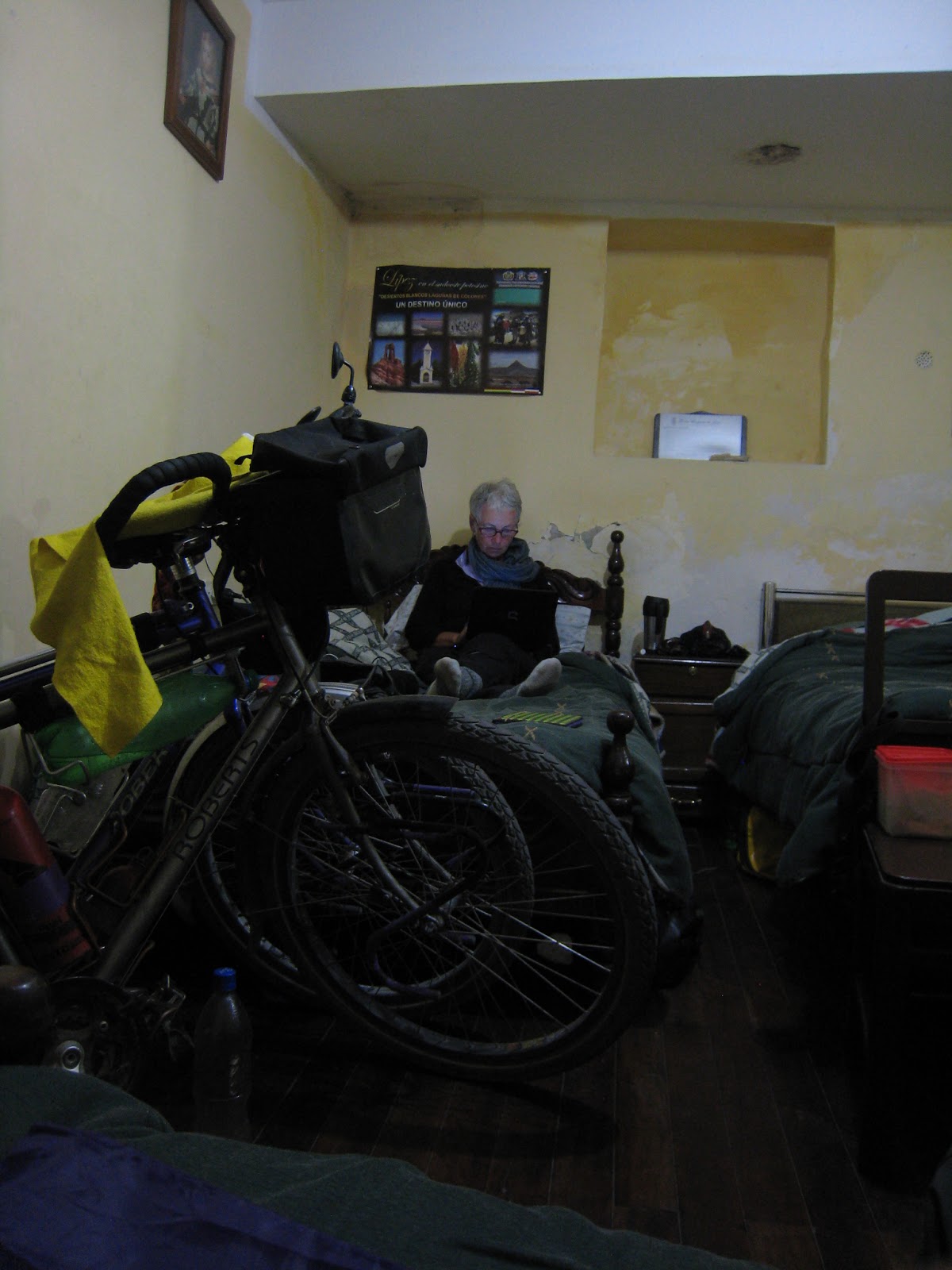
 I wonder what the fathers and brothers of the ‘Company of Jesus’ would make of the fact that one of their rooms has been transformed into a gringo howff. An order who adhered to abstinence and austerity, abnegation and renunciation, whilst we appear to be of the order buy and hoard, gear freak and technophile. Our bikes perched in one corner, our panniers exploded, disgorging their acquisition and accumulation across the wooden floor. The sparking plug trying to power up a reaffirmation, a temperance of coffee and mate de coca.
  Compaña de Jesús’, the Jesuits whose missions we visited over to the east in Paraguay. A monastery, a complex of buildings that fit together like loose jigsaw pieces. A small secluded courtyard, off which thread passages and tight alleyways, canyons where the sky is a mere strip, a line of light a few inches wide. The room was busy even before we arrived, with it’s three large beds, each with it’s smothering stack of quilts and woollen blankets, table, TV and bedside cabinets. Add our detonated collection and our cell becomes cosy, then with each succeeding day of occupation, entropic disorder sets in. A tent is easier to manage. Yet this chaotic eruption is a small price to pay for three centuries of imagined history.
 Did the brother who worked or slept here, trip every night on the low half step at the door during his nocturnal wanderings, as he rose to chant Matins at midnight? Did he curse the thin glass door that would do admirable service in a china cabinet to a latter day generation of Victorians? Did his conscience prick him for the inestimable mine deaths that plundered all the wealth of silver that he sent back to his Church and Crown in old-world Spain? Did it bother him that all his places of worship faced not the rising new day sun, but the hypocrisy of silver-rich Cerro Rico, to the mammon south? Or was he too busy persuading the rich, conscience-stricken mine owners to make a sin offering? A daughter to enter the purdah of Santa Teresa, perhaps, so that they could acquire an easy passage through the ‘pearly gates’ when their time came? And having accomplished this feat, further persuade them to endow the convent with many trappings of extravagance, ‘A surplice of gold and silver thread for the Bishop when he visits, would be nice’.
 where the old stops and the restored starts, but there is an aura of calm, of peace that pervades the place, that must have pervaded throughout the centuries. A single dry leaf, caught in an eddy, rustles around the courtyard, the wind a precursor for the afternoon deluge. The dirty underside of a thunderhead blots out my small sky, the skeletal shadows of the passion flower are scrubbed away, replaced by a diffused, flat light. The threat is there, but calm remains in my quiet monastical corner. A peace accentuated and in contrast to the amplification of an event that rolls out from the plaza. I’m convinced I’ve just heard Andean pipe rap. The bugling horns of jammed and frustrated cars, the barking dogs arguing with the crumping thunder. The deluge, when it hits, blankets over all other sound, the amping speakers are shorted out. But the respite is short lived. The klaxons slowly intrude, the traffic still constipated, whilst lost in my hermitage, I’m quiet and dry, lulled by a modern melodic canticle; the dripping water in the tin downpipe. A piece that starts with a rapid vibrato, moves to a wavering tremolo and concludes slowly, dissipating to a lethargic protracted conclusion. The second half of the concert is just as modern, but not nearly as soothing. A score that might have been composed in Detroit, Birmingham or Linwood, but no more. Antiphonal, as two collectivos debate supremacy of one junction, verses of frustration, exchanges that nobody listens to, all to a background of a car alarm. An habañera of auto horns that dance on and on, incessant, discordant, a nocturne that will play long into the dark.


